
Assessment
Many pupils’ struggle to engage in initial formal assessments. To secure and identify an appropriate personalised learning provision, we gather as much information as possible from the pupil’s statutory Educational and Health Care Plans (EHCP), meetings with parent/carers, previous schools (if available), during transition, observations, formal assessment (where appropriate) specialists and school reports. We recognise that many pupils often have spiky profiles, where they excel in one area but may struggle in another.
Photographs, videos and written observations are taken and recorded using the 'Evidence for Me' App. This evidence, along with teacher judgement, and pupil’s creations/work help to create a picture of which Stepping Stone the children are working within. Provision Plan targets are also assessed and updated three times a year, as well as during the EHCP annual review working alongside parents.
This is an example of our assessment grid of Stepping Stone 4-6 as an example of progression
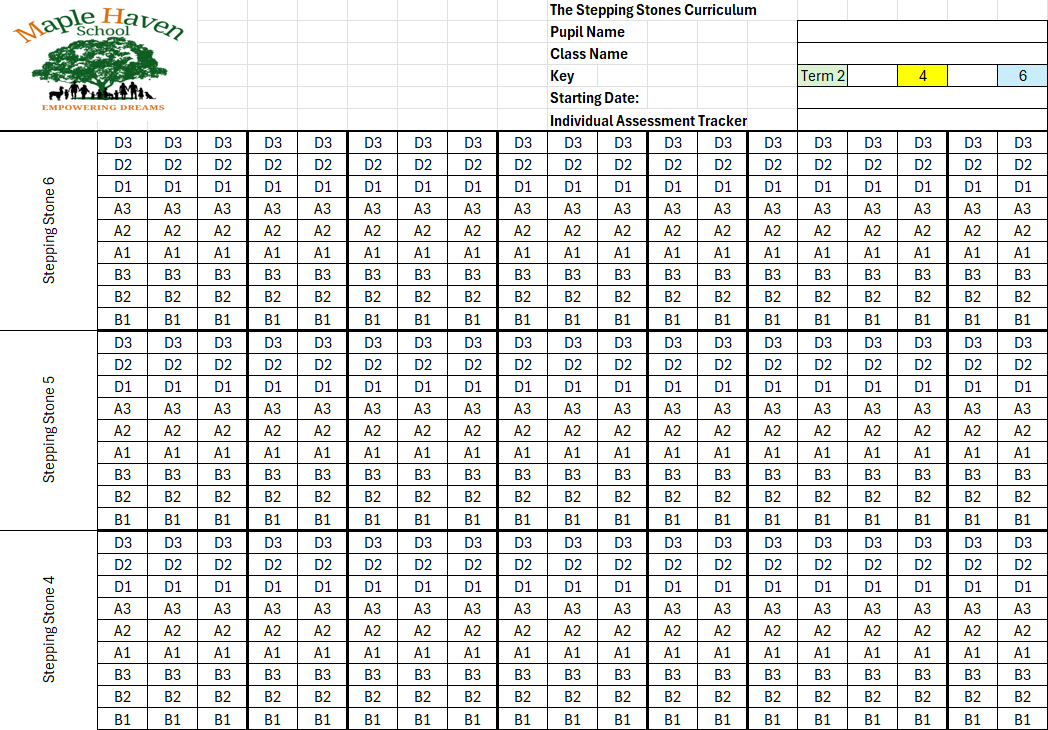

When pupils move on to Pathway 2 and beyond, we use the B Squared assessment system to assess, record and track progress over time. This system enables staff to identify even the smallest steps of progression and provides a clear framework linked to Primary and Secondary National Curriculum expectations, where appropriate. In doing so, it supports equitable access to the curriculum for all pupils.
Pupils experiencing our semi-formal curriculum can access a range of ‘National Curriculum subjects for their Key Stage with a strong focus on English and Mathematics programmes, using the ‘Progression Steps’. These are modified and adapted to be “meaningful and functional’’ in the light of their developmental level and special educational needs.
Programmes become more structured, with learning, where possible, linked to practical and creative activities to promote engagement and sustain pupil interest. A strong emphasis is placed on the development of functional skills, including the use of technology to research information, reinforce learning, use maps, follow recipes, and plan and cost activities such as educational visits.
Extended and enriching learning opportunities may include IT, music, animal care and a range of other experiences tailored to pupils’ interests and needs. These opportunities support incidental learning and the development of functional life and self-help skills, while also contributing to improved confidence, positive behaviour and attitudes to learning.
Our assessment systems draw on a wide range of evidence to build a clear picture of what pupils know, understand and can do across the curriculum, while also identifying precise next steps for learning and progress.
Regular pupil progress monitoring enables staff to identify any gaps in learning, inform responsive planning and ensure that all pupils make progress from their individual starting points through well-targeted teaching and learning experiences.